






















Recently, Dango has received considerable feedback from users in China and overseas about extracting AI-generated songs, mostly asking about extraction quality for this kind of music.
We therefore felt a separate article was needed to explain the quality, extraction, and future compatibility of these songs in one place.
Can Dango AI Extract AI-Generated Songs?
The brief answer: the current 11.0 algorithms offer limited support, while the upcoming 12.0 will support this audio more fully. Besides a major overall improvement in model performance, 12.0 will include targeted optimization for extracting AI-generated audio.
AI Music Breaks the Usual Patterns
AI music generation software, led by Suno, has been around for several years, and this year has seen an explosion of such songs. They are everywhere online and can even be heard regularly in convenience stores and shopping malls.
When Dango’s 11.0 series launched in the middle of last year, we were already watching this music, but did not optimize deeply for it then. The reason is that AI-generated music is extremely unstable in nature, limiting our targeted optimization during the 11.0 phase.
Most listeners mainly care whether a song sounds good, but from Dango’s technical perspective, track accuracy is what matters. AI-generated music has very blurry boundaries between vocals and instrumentals: halfway through a hummed phrase, the voice often gradually transforms into an accompanying instrument. The instrumental also breaks the rules. A previously regular drum pattern may suddenly stop being generated where the vocal masks it. A drum sound is genuinely missing from that section, leaving a hole that a particular vocal sound, such as sibilance, happens to cover. Ordinary listeners struggle to notice.
AI-generated vocals are also very… extreme🤨 (if you know, you know.jpg). They often produce astonishing sounds that a human throat could hardly sing. These counterintuitive audio patterns are common in AI music, running contrary to Dango AI’s approach of extensive training on real music and making this style difficult for Dango to extract.
This relates to how AI music is trained. Like a large language model, it requires post-training: generate N songs, have internal evaluators or volunteers score them, then feed the audio humans like best back into itself, bootstrapping iterations of music that humans prefer.
Without professional training, however, most people struggle to hear flaws such as the timbral blending or missing instruments described above. When scoring, they focus more on whether the whole song sounds good and stays in tune. Human ratings therefore push the AI to care less about accuracy and more about pleasant sound, converging with user preferences.
Dango’s extraction algorithms take the opposite approach: they do not care whether a song sounds good or is sung in tune. As long as it is vocals, it can be extracted, whether heartfelt singing or howling. What Dango really cares about is the underlying musical structure. Vocals suddenly blurring into instruments mid-phrase or instrumental sounds disappearing for no reason—issues that simply do not occur in normal music—are everyday occurrences in AI songs.
Faced with content that violates normal musical structure, the current 11.0 algorithms must rely on their existing real-song extraction ability. Once an AI song’s structure becomes too chaotic, extraction can easily fail.
If You Cannot Beat Them, Join Them?
Some users may ask what all this talk is about: why not simply let Dango learn AI songs?
Before we can get anywhere, the first issue immediately approaching us is copyright.
For example, Suno’s terms (Conditions of Access and Use 10.) strictly prohibit any further AI training using outputs generated by its product.
Worse still, even without such contractual restrictions, Dango still could not benefit from learning these songs🤣
Simply put, separation models like Dango need extremely clean vocal and instrumental tracks for training, learning how to reverse their mixing process and extract them separately. AI-generated songs, however, are not made by generating N internal tracks and then mixing them together. They directly output the final audio.
This means these songs inherently have only a mix; clean individual tracks do not exist. As a result, they cannot provide that learning material.
Suno does offer track extraction, but its quality is concerning and often less reliable than Dango. Even if various tracks are extracted with Suno, they are not clean. Whether extracted by Dango 11.0 or Suno, the audio already contains errors. Hoping to bootstrap Dango AI’s learning using such erroneous audio would only worsen its extraction performance.
AI-Generated Songs Have Their Own Artifacts
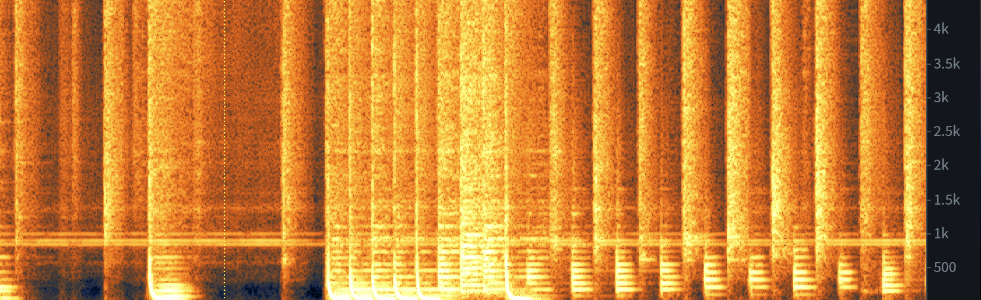
Dango’s audio development team recently noticed that, since Suno v6 launched in August, audio generated with v6 has strong artifact traces. After Dango or other algorithms remove vocals from v6 audio, the remaining instrumental contains obvious low-to-mid-frequency humming artifacts.
Dango does not know whether this is an intentional Suno watermark or an algorithmic flaw. What we do know is that this watermark is hard to hear in the original song because of auditory masking, but becomes obvious in the instrumental after vocal removal, making the output unusable.
What Next? What Is Dango’s Response?
Because AI-generated songs have no original separate vocal/instrumental tracks, Dango cannot learn from them to improve removal of this style. The watermark issue appearing since August makes extracting AI-generated songs increasingly challenging😰
All of the above was our preamble (how would you appreciate the difficulties of Dango’s development and optimization without first hearing the challenges.jpg). What we want to say next is:
Dango 12.0 will specifically optimize extraction for this audio, remove watermark artifacts, and greatly improve extraction accuracy👻👻👻👻
At the start of the 12.0 project, Dango had already organized these issues and challenges and included them among its optimization goals. To be honest, improving extraction of AI-generated songs is barely worth mentioning among 12.0’s advances. Version 12.0 will bring very clear accuracy improvements to any song, in any style👻
Dango has already found a feasible targeted optimization method and successfully tested it. Internal tests show a huge decrease in incorrect extraction of AI-generated audio, such as frequently removing certain instruments as vocals.
We will also provide an additional option across all 12.0 algorithms. Enable it to specifically remove AI-generated watermark artifacts. We have optimized the entire experience for this audio, for those of you with exceptionally demanding sound-quality standards👻


