





















October flew by 👻 Last month’s log mentioned that we would return our focus to Lossy-Audio Fixer. This month, we can reveal the results~
The verdict first: it looks promising! 👻👻
We conducted 312 experiments in October and achieved a clear breakthrough. In our earlier experiments, we explained that lossy audio restoration can be divided into envelope restoration and texture restoration. The envelope can be thought of as the spectrogram’s noise floor, or the shape of each instrument. It is easy to learn; even ordinary statistical algorithms, without deep learning, can recover meaningful high-frequency envelopes from low frequencies. But the envelope is only part of what needs restoring. Texture is more important: harmonics in harmonic instruments, for example, or lines in synthesizer sounds. We call these textures to make them easier to understand.
Imagine a photograph of a building: the envelope is its overall tall rectangular shape, while texture is the bricks and windows. To a neural network, the envelope is relatively easy low-frequency information, while texture is difficult high-frequency information. Here is the interesting part: our restoration target is itself a spectrogram. Dango works on spectrograms rather than pure waveforms or a hybrid domain like demucs 👻. The spectrogram is an STFT of the waveform and already contains low- and high-frequency information. When treating the magnitude spectrum as an image, its low and high spatial frequencies correspond to what we call envelope and texture. Previously, we were stuck with restoring envelopes and simple textures, unable to recover complex high-frequency texture. This month, we broke through that obstacle, and the network can now restore substantial, robust texture information.
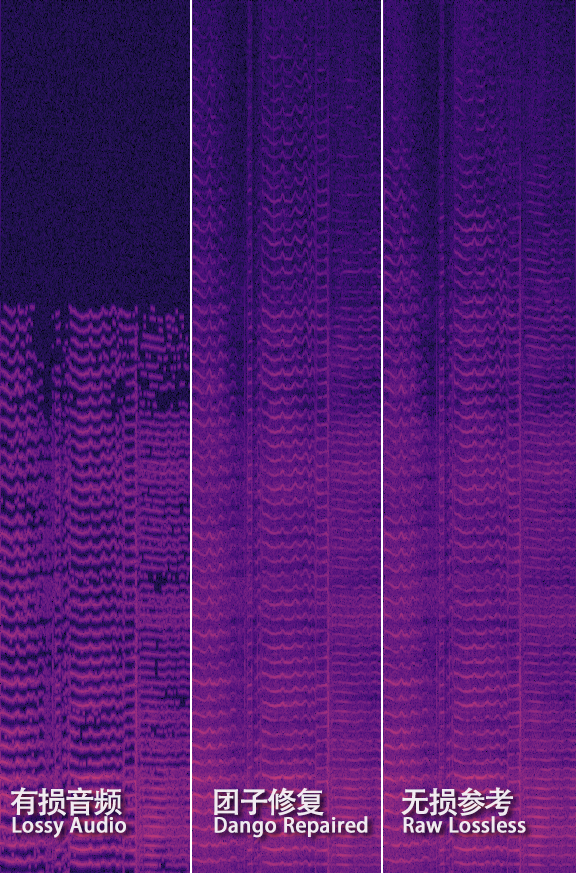
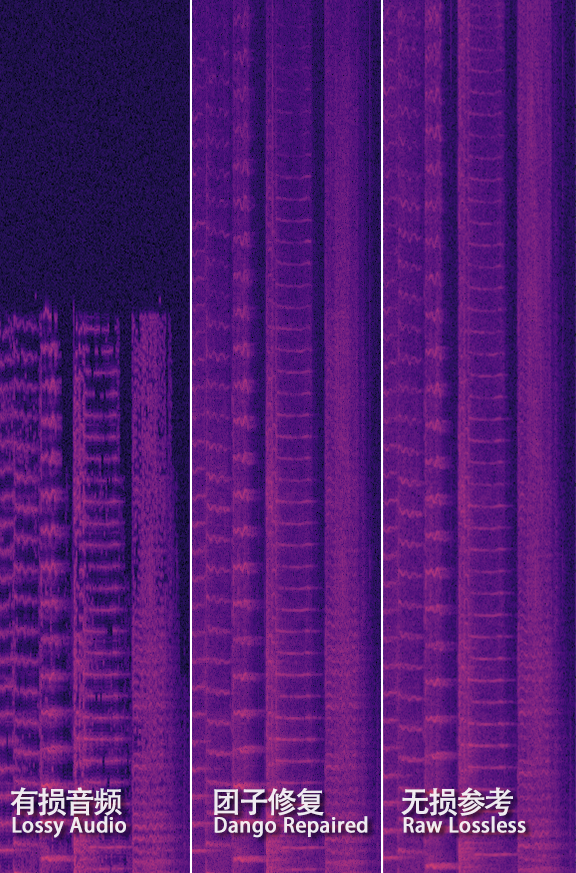
We have shared two example images. Compared with before, Dango can now generate highly meaningful high frequencies, an unprecedented achievement. As far as we know, neither current commercial products nor academic research can reach our restoration level. This is a major breakthrough, confirming we can continue down this path 👻👻
Generating reliable texture is only one part of the difficulty. First, the examples show some areas where texture generation is still unsatisfactory, but these models were trained on small datasets. Once reliability is confirmed, we will train larger models with more data. Second, unlike audio super-resolution, lossy restoration is more complex. Super-resolution only extends frequencies above a cutoff, but lossy codecs also damage low and mid frequencies, producing artifacts or visible spectral holes. Damage varies with songs, codecs, and even codec settings. The network must fill in high frequencies, repair lows and mids, and introduce no artifacts or audible abnormalities. This remains a major challenge, but these issues are relatively solvable 👻👻 Dango has accumulated extensive experience through years of audio AI work, and we believe the internet’s first audio restoration feature is not far away 👻👻
In summary, we have achieved a breakthrough in small-scale experiments, but scaling up training and obtaining the necessary high-quality data, plus restoring low, mid, and high frequencies as described above, remain to be resolved. Completing the feature may still take considerable time. We expect to announce a concrete schedule in early December (passing the buck to next month.jpg).
Some users also sent us unusual feedback: certain websites advertise their products’ SDR numbers and try to compare them with Dango.
We have used this term in many product introductions. Simply put, SDR is a scientific evaluation metric that measures roughly how similar generated content is to the original. Higher SDR means closer to the original audio, or objectively better.
You may have seen instrumental extraction websites advertising “SDR scores as high as XXX” (some even claim SDR scores above 24 🤣). SDR is like an exam score for source separation. Higher scores usually indicate better ability to separate vocals and instrumentals, but there is a crucial catch: the score depends entirely on which exam it takes—the dataset. Different datasets are like different exam papers, some easy and some extremely difficult. A tool may easily score 95 on an easy paper but only 70 on a hard one. Some datasets focus on classical music, others on electronic music.
So when two websites boast about their SDR scores but use entirely different test songs and tracks, comparing the scores is like one person running a marathon and another playing Go, then asking who cooks better 🤣
The open-source musdb18 dataset is commonly used in the industry. For its others track, a score of 10–12 is already excellent. Some platforms use their own datasets, such as MVSEP, where 14–18 is also excellent.
Every SDR value mentioned by Dango is tested on our internal dataset, covering many musical styles, languages, and effects such as compression and recording conditions. Because the standards differ, we never directly compare scores with other platforms. We only compare with our own previous-generation models—using the same exam paper makes claims of percentage improvement truthful and rigorous.
For perspective, an SDR above 24 is an extraordinary claim. If SDR measures the difference between a high-quality 192/320 kbps MP3 and lossless audio, the score is only around 23–25. That is already extremely hard for human ears to distinguish. We can say definitively that, without professional training, listeners cannot hear the difference at an SDR of 24. Even Dango, which prioritizes sound quality, would never dare boast like that 🤣
Next time you see impressive SDR scores, look carefully. The number itself may be real, but it may not represent the result on your song. Ultimately, your ears must judge the technology. Listen for clean, lossless separated sound—that is the most reliable test.


